Showing posts with label concrete. Show all posts

concrete - Gradation and Size


Gradation Test
The gradation of a particular aggregate is most often determined by a sieve analysis .  In a sieve analysis, a sample of dry aggregate of known weight is separated through a series of sieves with progressively smaller openings. Once separated, the weight of particles retained on each sieve is measured and compared to the total sample weight.  Particle size distribution is then expressed as a percent retained by weight on each sieve size. 

brick - The Impact of Grout

The Impact of Grout

Full Joint shown above.To a remarkable degree, impressive grout techniques, both in color hue and finished joint methods, significantly enhance the beauty and authenticity of Eldorado Brick installations. From exterior brick veneer to brick fireplace surrounds, using Eldorado Brick with any of a number of notable grout techniques assures you, not only of the old-world charm you desire, but the believability you expect.


Standard Joint Grout Technique

In this illustration, Castello RomaBrick is installed with a gray grout in a standard, raked joint finish. A joiner or other blunt masonry instrument is used to achieve a consistent depth which creates the familiar concave, raked out look to the mortar.

Overgrout Grout Technique

When you compare this photograph with the photo of the standard joint, you’ll notice how different the brick looks. In both instances, Castello RomaBrick was selected, but the grout technique makes the brick look much different. The same gray grout is used but the mortar overlaps the face of the brick, widening the joints and producing an irregular, rustic look.

Weep Joint Grout Technique

Riverbed TundraBrick demonstrates a most dynamic and expressive technique often called “weep.” The colored grout literally oozes out of the joints to appear as though there’s been too much grout squeezed into the joints. The distinctive “weeping” creates the unique surface texture seen in many installations.
Bead Joint Grout Technique
Cleaner-lookin and more controlled than a weep joint, this technique has grout still extruding beyond the brick face. Riverbed TundraBrick used here is the same brick as used in the weep joint photo, but with different visual results. In both circumstances, the grout color and technique alters the face of         the brick slightly.

Grapevine Joint Grout Technique

Here, Panzano ModenaBrick with a colored grout is featured with a unique technique often referred to as a grapevine joint. Dragging a thin, blunt instrument (not unlike a twig) along the middle of the wet grout – horizontally and vertically – scores the grout leaving a thin visible linear cavity.

Full Joint Grout Technique

When you compare this grout technique with the photo of the grapevine joint, you can see how grout technique influences the perception of the installed brick. Once again, using Panzano ModenaBrick with a colored grout, this full joint is similar to a standard joint. However, the grout level is almost flush with the face of the brick, slightly exposing the edge detail.

Concrete - Admixture in Concrete

Mineral Admixtures

Mineral admixtures (fly ash, silica fume [SF], and slags) are usually added to concrete in larger amounts to enhance the workability of fresh concrete; to improve resistance of concrete to thermal cracking, alkali-aggregate expansion, and sulfate attack; and to enable a reduction in cement content.

Fly ash

-Fly ash is one of largest emissions of the industrial waste residues in current China. 
 -the emissions of fly ash from coal-fired power factories will increase year by year. A large number of unprocessed fly ash will generate dust and pollute the atmosphere
-discharged into the water system cause the rivers blockage and the toxic chemicals contained in it will be harmful to the human body and life-forms.
-If added to the concretes directly they will save a lot of cement raw materials


Silica Fume

- also known as microsilica, is a byproduct of the reduction of high-purity quartz with coal in electric furnaces in the production of silicon and ferrosilicon alloys.
-collected as a byproduct in the production of other silicon alloys such as ferrochromium, ferromanganese, ferromagnesium, and calcium silicon.
-Before the mid-1970s, nearly all Silica Fume was discharged into the atmosphere, After environmental concerns necessitated the collection and landfilling of Silica Fume, it became economically justified to use Silica Fume in various applications.
-Silica Fume is a highly effective pozzolanic material
-used in concrete to improve its properties.
- improves compressive strength, bond strength, and abrasion resistance; reduces permeability; and therefore helps in protecting reinforcing steel from corrosion.

Slag

-made by intergrinding the granulated slag with portland cement clinker (blended cement), has been used for more than 60 years, the use of separately ground slag combined with portland cement at the mixer as a mineral admixture.
- granular material formed when molten iron blast furnace slag is rapidly chilled (quenched) by immersion in water.
-granular product with very limited crystal formation, is highly cementitious in nature and, ground to cement fineness, hydrates like portland cement.


Chemical Admixtures

Chemical admixtures are added to concrete in very small amounts mainly for the entrainment of air, reduction of water or cement content, plasticization of fresh concrete mixtures, or control of setting time.

Air-Entrainment

-the process whereby many small air bubbles are incorporated into concrete and become part of the matrix that binds the aggregate together in the hardened concrete.
-air bubbles are dispersed throughout the hardened cement paste but are not, by definition, part of the paste
-the formation of minute air bubbles dispersed uniformly through the cement paste increased the freeze-thaw durability of concrete
-ormation can be achieved through the use of organic additives, which enable the bubbles to be stabilized or entrained within the fresh concrete 

Water-Reducing

- groups of products that are added to concrete to achieve certain workability (slump) at a lower w/c than that of control concrete 
-sed to improve the quality of concrete and to obtain specified strength at lower cement content.
-improve the properties of concrete containing marginal- or low-quality aggregates and help in placing concrete under difficult conditions.
-categorized according to their active ingredients:-
  1. salts and modifications of hydroxylized carboxylic acids (HC type);
  2. salts and modifications of lignosulfonic acids (lignins); and
  3. polymeric materials (PS type).

Set-Retarding

-delay hydration of cement without affecting the long-term mechanical properties.
-used in concrete to offset the effect of high temperatures, which decrease setting times, or to avoid complications when unavoidable delays between mixing and placing occur
-Use of set retarders in concrete pavement construction
1) enables farther hauling, thus eliminating the cost of relocating central mixing plants;
 2) allows more time for texturing or plastic grooving of concrete pavements;
3) allows more time for hand finishing around the headers at the start and end of the production day; and
4) helps eliminate cold joints in two-course paving and in the event of equipment breakdown 
-to resist cracking due to form deflection that can occur when horizontal slabs are placed in sections

Accelerating

-added to concrete either to increase the rate of early strength development or to shorten the time of setting, or both
-accelerators include some of inorganic compounds such as soluble chlorides, carbonates, silicates, fluosilicates, and some organic compounds such as triethanolamine.
-Among all these accelerating materials, calcium chloride is the most common accelerator used in concrete.
-growing interest in using "chloride-free" accelerators as replacement for calcium chloride has been observed  because calcium chloride in reinforced concrete can promote corrosion activity of steel reinforcement, especially in moist environments.

Superplasticizers

-developed in Japan and Germany in the early 1960s
-Superplasticizers are linear polymers containing sulfonic acid groups attached to the polymer backbone at regular intervals. Most of the commercial formulations belong to one of four families:
  • Sulfonated melamine-formaldehyde condensates (SMF)
  • Sulfonated naphthalene-formaldehyde condensates (SNF)
  • Modified lignosulfonates (MLS)
  • Polycarboxylate derivatives

concrete - Chemical Properties and Physical Properties

CHEMICAL PROPERTIES 
The chemical properties of aggregates have to do with the molecular structure of the minerals in the aggregate particles.

  • Stripping (HMA)
Although the displacement of asphalt on the aggregate particle surface by water (stripping) is a complex phenomena and is not yet fully understood, mineralogy and chemical composition of the aggregate have been established as important contributing factors (Roberts et al., 1996).  In general, some aggregates have an affinity for water over asphalt (hydrophilic).  These aggregates tend to be acidic and suffer from stripping after exposure to water.  On the other hand, some aggregates have an affinity for asphalt over water (hydrophobic).  These aggregates tend to be basic and do not suffer from stripping problems.  Additionally, an aggregate’s surface charge when in contact with water will affect its adhesion to asphalt cement and its susceptibility to moisture damage.  In sum, aggregate surface chemistry seems to be an important factor in stripping.


  • Alkali-Aggregate Reaction (PCC)

Alkali-aggregate reaction is the expansive reaction that takes place in PCC between alkali (contained in the cement paste) and elements within an aggregate.  The most common is an alkali-silica reaction.  This reaction, which occurs to some extent in most PCC, can result in map or pattern crackingsurface popouts and spalling if it is severe enough.


Physical Properties


The physical properties of aggregates  are those that refer to the physical structure of the particles that make up the aggregate. 
Commonly measured physical aggregate properties are :
  • Gradation and size
  • Toughness and abrasion resistanc
  • eDurability and soundness
  • Particle shape and surface texture
  • Specific gravity
  • Cleanliness and deleterious materials.


 Aggregates Before a Soundness Test


 Aggregates After a Soundness Test

Concrete - Type of Aggregate

FINE   AGGREGATE
   “Fine   aggregate”   is defined as material that will pass a No. 4 sieve and will, for the most part, be retained on a No. 200 sieve. For increased workability and for economy as reflected by use of less cement, the fine aggregate should have abounded shape. The purpose of the fine aggregate is to fill the voids in the coarse aggregate and to act as workability agent.

COARSE AGGREGATE
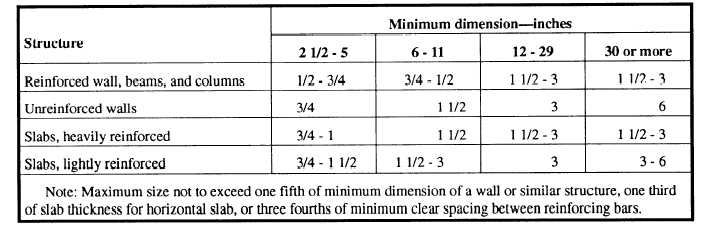
Coarse aggregate is a material that will pass the 3-inch screen and will be retained on the No. 4 sieve. As with fine aggregate, for increased workability and economy as reflected by these of less cement, the coarse aggregate should have abounded shape. Even though the definition seems to limit the size of coarse aggregate, other considerations must be accounted for. When properly proportioned and mixed with cement, these two groups yield an almost void less stone that is strong and durable. In strength and durability, aggregate must be equal to or better than the hardened cement to withstand the designed loads and the effects of weathering. It can be readily seen that the coarser the aggregate, the more economical the mix.  Larger pieces offer less surface area of the particles than an equivalent volume of small pieces. Use of the largest permissible maximum size of coarse aggregate permits a reduction in cement and water requirements. One restriction usually assigned to coarse aggregates its maximum size. Larger pieces can interlock and form arches or obstructions within a concrete form. That allows the area below to become a void, or at best, to become filled with finer particles of sand and cement only.  That  results  in  either  a  weakened  area  or  cement-sand  concentration  that  does  not  leave  the proper proportion to coat the rest of the aggregate. The maximum size of coarse aggregate must be no larger than the sizes given in table 13-1. The capacity of the mixing   equipment   may   also   limit   the   maximum aggregate size.

Concrete - Aggregates


Aggregates are inert granular materials such as sand, gravel, or crushed stone that, along with water and portland cement, are an essential ingredient in concrete. For a good concrete mix, aggregates need to be clean, hard, strong particles free of absorbed chemicals or coatings of clay and other fine materials that could cause the deterioration of concrete. Aggregates, which account for 60 to 75 percent of the total volume of concrete, are divided into two distinct
 categories-fine and coarse. Fine aggregates generally consist of natural sand or crushed stone with most particles passing through a 3/8-inch (9.5-mm) sieve. Coarse aggregates are any particles greater than 0.19 inch (4.75 mm), but generally range between 3/8 and 1.5 inches (9.5 mm to 37.5 mm) in diameter. Gravels constitute the majority of coarse aggregate used in concrete with crushed stone making up most of the remainder.  

Storage of aggregates at quarry
Natural gravel and sand are usually dug or dredged from a pit, river, lake, or seabed. Crushed aggregate is produced by crushing quarry rock, boulders, obbles, or large-size gravel.Recycled concrete is a viable source of aggregate and has been satisfactorily used in granular subbases, soil-cement, and in new concrete. Aggregate processing consists of crushing, screening, and washing the aggregate to obtain proper cleanliness and gradation. If necessary, a benefaction process such as jigging or heavy media separation can be used to upgrade the quality.

Once processed, the aggregates are handled and stored in a way that minimizes segregation and degradation and prevents contamination. Aggregates strongly influence concrete's freshly mixed and hardened properties, mixture proportions, and economy. Consequently, selection of aggregates is an important process. Although some variation in aggregate properties is expected, characteristics that are considered when selecting aggregate include:
  • grading
  • durability
  • particle shape and surface texture
  • abrasion and skid resistance
  • unit weights and voids
  • absorption and surface moisture
Wheel showing various grades of aggregates
Grading refers to the determination of the particle-size distribution for aggregate. Grading limits and maximum aggregate size are specified because grading and size affect the amount of aggregate used as well as cement and water requirements, workability, pumpability, and durability of concrete. In general, if the water-cement ratio is chosen correctly, a wide range in grading can be used without a major effect on strength. When gap-graded aggregate are specified, certain particle sizes of aggregate are omitted from the size continuum. Gap-graded aggregate are used to obtain uniform textures in exposed aggregate concrete. Close control of mix proportions is necessary to avoid segregation.

Concrete Canoe Fail


The video above show that is a concrete canoe competition whereby the  concrete canoe are made by some students from different university. One of the canoe fail during the competition.

Concrete - Concrete Pouring

MODERN CONCRETE POURING

From this video, we can know that the concrete pouring is faster by using the machine if compared to the using of labor.


COMICS : CONCRETE PUMP

The illustration below show about the safety and welfare risks to all construction stakeholders ( especially the workforce) to prevent accidents on site.

FUNNY ADVERTISEMENT ABOUT CONCRETE

This is an advertisement about the fast drying concrete. It really gets the point to across. ^^

Concrete - Creative Buildings Made By Concrete

CREATIVE BUILDINGS MADE BY CONCRETE

Saint-Pierre de Firminy Church
This building was located in France. It is so unique because of its conical roof. The conical roof was built by a special concrete called Agilia.

Phaeno Science Center 
This building was located in England. It has a 20 feet high conical columns to support the whole building. Some visitors come here even not for the science but for the design of the building.

Torre Agbar 
This building was located in Barcelona. It is a water supply company and its headquarters was made by two cylindrical concrete.

Pavillon Noir
We can see the concrete bars from this building. It is for ballet performance and  their rehearsal.

RATP Bus Center 
This bus center is located in Paris. It was designed to manage 200 bus everyday from day to night

Jubilee Church
This church had celebrated the 2000 anniversary of Christianity. It was made by a special concrete. This concrete not only self-cleaning, but also absorb pollutants.

Translucent Dressing Room 
This dressing room is located in England. We can see that its wall was made by concrete and actually the thickness of the wall not more than two inches.

Concrete - Creative Products Made from Concrete

CREATIVE PRODUCT MADE BY CONCRETE

coffee machine

toys blocks

flower pot

chairs

bathroom

concrete house

Concrete - Tests

CONCRETE TEST
Different kinds of concrete test have been defined out such as below:

COMPRESSIVE STRENGTH TESTS


Strength tests are required for one or both of the  following purpose:
   1. To check the potential strength of the concrete under controlled conditions against the desired strength; and
    2. To establish a strength-age relationship for the concrete under job conditions as a control for construction operations or the opening of the work.
Appendix 1.1: Compressive strength tests

FLEXURAL STRENGTH TESTS

These routine tests are usually made only on paving jobs and are tested at the job site. The value of the standard flexural test results depend entirely on uniform adherence. Tests are normally made at the standard ages of 7 and 28 days. High early strength concrete may require additional beams to verify opening strengths.

Appendix 1.2: Flexural strength tests

CONSISTENCY (SLUMP) TESTS

Check and control the consistency of the concrete during each pour.
Appendix 1.3: Consistency (slump) test

AIR CONTENT TESTS
The slump test is a measure of the consistency of the concrete.
Appendix 1.4: Air content test

UNIT WEIGHT (DENSITY) TEST
The unit weight (density) test is a measure of the weight per cubic meter (cubic foot) of freshly mixed concrete. By knowing the unit weight of the concrete, other information can be determined such as the concrete yield and water content for microwave oven testing.

Appendix 1.5: Unit weight (density) test


TEMPERATURE TEST

The Inspector should determine and record the concrete temperature at time of placement. Unless the Special Provisions for the Contract provide otherwise, the concrete temperature requirement is in the range of 10 to 30°C.

Appendix 1.6: Temperature test